Helpful terminology and definitions
 Standard Reports Package
Payroll reports generated by Dayforce each pay.
See also
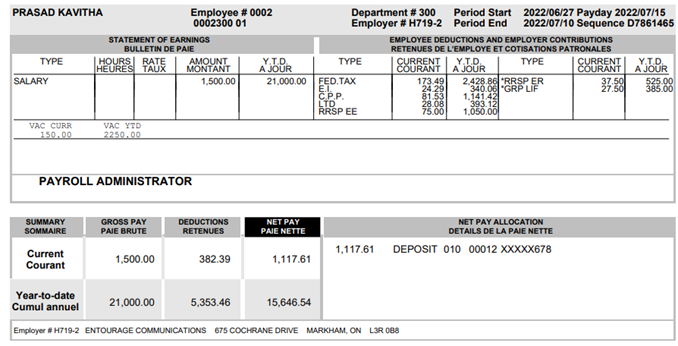
Pay Statement
|
Term |
Definition |
|---|---|
|
Deduction |
Any amount withheld from an employee’s pay. |
|
EFT |
Electronic Funds Transfer are also known as direct deposit. |
|
Gross Pay |
An employee’s total pay before deductions and taxes have been subtracted. |
|
Net Pay |
Net pay is the amount after taxes and deductions have been subtracted from an individual’s gross pay. |
|
Pay Period End date |
A pay period end date is the cutoff for the timeframe the employees are being paid. |
|
Pay Statement |
A statement of earnings the employers provides to their employees. It is also referred to as a pay slip. |
|
Payment date |
The date the employees’ direct deposits (EFT) are received, and their cheques are cashable. |
|
Salary |
A fixed regular payment issued to an employee. |
|
Year to Date (YTD) |
YTD is the total of employee earnings, deductions and benefits beginning at the start of the calendar or fiscal year up to the current payroll date. |
 Payroll Compliance
Payroll Forms
Payroll Compliance
Payroll Forms
|
Term |
Definition |
|---|---|
|
Amended tax forms |
A T4 or RL-1 that is corrected after the tax forms are filed with Canada Revenue Agency (CRA) and Revenu Québec |
|
CPT30 |
Government form that allows employees aged 65 to 69 to opt out of CPP contributions. |
|
PD7A - Statement of Account for Current Source Deductions. This statement is sent by CRA to businesses who have remitted Canada Pension Plan (CPP) contributions, Employment Insurance (EI) premiums, and income tax deductions to CRA. The customer will use this statement to reconcile remittances received by CRA to the values displaying on their payroll reports. Note: Dayforce does not have access to these statements. E-PD7A - An electronic service that allows employers to receive and view their Statement of Account for Current Source Deductions online through the CRA site. |
|
|
Record of Employment (ROE) |
An ROE is a document that employers must issue when there is an interruption in an employee’s earnings. |
|
Tax Form |
Form that must be submitted to the Canada Revenue Agency (CRA) and Revenu Québec (RQ) each financial year for individuals or corporations earning an income in Canada, for example T4 or Releve 1. Generic term used for T4, T4A, NR4, RL 1 and RL 2 slips. |
|
NR4 |
This statement shows amounts paid or credited to a non-resident recipient during the year, and the tax withheld. |
|
RL-1 (Releve 1) |
This provincial slip must be filed by any employer or payer that paid any of the following to a Québec employee:
|
|
RL-2 (Releve 2) |
This provincial slip must be filed by any employer or payer that paid retirement or annuity income to a Québec employee. |
|
T4 |
This federal slip must be filed by any employer or payer that paid:
|
|
T4A |
This federal slip must be filed by any employer or payer that paid any of the following to an employee.
|
|
TD 1 |
Form used to determine the amount of tax to be deducted from an individual's employment income or other income. There are federal and provincial/territorial forms. |
|
TP1015.3-V |
Form used to determine the amount of tax to be deducted from an individual's employment income or other income used by individuals reporting to the province of Québec. |
Powerpay Terminology
|
Term |
Definition |
|---|---|
|
Active |
Employee Status option in Powerpay. Active, able to be paid |
|
Accumulator |
Amount of vacation pay that an employee has earned according to a company’s policy or the jurisdiction’s employment standards but has not yet been paid. It is also referred to as an accrual. |
|
Extra Run |
A payroll run that is not part of the regular series of payroll runs defined in the calendar. |
|
Garnishment |
The information on garnishments of wages, maintenance and support orders in this section is intended to be a guide. Consult legal counsel if an order is served against an employee. In most jurisdictions, exemption amounts can be prorated if employees are remunerated more frequently than once a month. Also, in some cases, judges have the authority to vary exemption amounts specified under a garnishment or maintenance order. |
|
Manual |
A method of data entry that allows Powerpay users to update year to date employee information without creating payment. Manuals allow Dayforce to allocate the earnings to the applicable pay period ensuring a correct EI history as well as remitting the applicable statutory deductions to the government agencies. |
|
On Leave |
Employee Status option in Powerpay. On leave employees will remain in Powerpay indefinitely. |
|
Pay Period End date |
A pay period end date is the cutoff for the timeframe the employees are being paid. |
|
Regular Run |
A payroll run that initiates payroll processing. The number of regular runs scheduled is based on the company’s payroll frequency. |
|
Reversal |
A method of entry in Powerpay used to correct a previous payment. Reversals allow Dayforce to allocate the earnings to the applicable pay period ensuring a correct EI history as well as correct the applicable statutory deductions to the government agencies. |
|
ROE Run |
A run that produces ROE forms for employees between regular payroll runs. ROE runs DO NOT produce payments. |
|
Second Payment |
Second Payment is another payment type that produces a second cheque or direct deposit for an employee. |
|
Submit by date |
The date the payroll must be submitted to Dayforce to ensure on time employee payments. |
|
Terminated |
Employee Status option in Powerpay. Terminated employees will be removed from Powerpay on the first payroll run of the year. |
|
YTD Adjustment page |
An employee level Powerpay page used to correct or enter Year-to-Date information for a client’s payroll. Clients do not have access in their Powerpay accounts. These entries are used to update tax forms but do not calculate or send remittances. |
Year-end Terminology
|
Term |
Definition |
|---|---|
|
Mass Filing (aka mag tape) |
Refers to the electronic file that Dayforce sends to CRA (Canada Revenue Agency) & Revenu Québec. This file contains a copy of each employee’s tax forms (T4, T4A, NR4, RL-1, RL-2), and the company’s T4 Summary. It does not include the RL-1 and RL-2 Summary. |
|
Matrix |
The matrix is part of the Year End Balancing reports. It lists all earning, deduction and benefit codes set up for the account and details the source deduction calculations and tax form reporting. |
|
Pension Adjustment (PA) |
Value of the benefits an employee earned in a tax year under their employer's Registered Pension Plan, Deferred Profit-Sharing Plan, and possibly, unregistered retirement plans or arrangements. Clients do not usually receive these amounts from their providers until January for the previous year. This is not the same as a CPP/QPP deficiency adjustment. |
|
Pensionable and Insurable Earnings Review (PIER) |
A deficiency report produced by the Canada Revenue Agency when the total Canada Pension Plan contributions and/or Employment Insurance premiums reported on the T4 information slips do not equal the amount calculated on reported pensionable and insurable earnings. |
|
Preliminary Year-end Balancing Reports |
Reports that detail the information on the Dayforce masterfile up to and including the first payroll run with a November payment date. |
|
Stock Option |
Benefit in the form of an option given by a company to an employee to buy stock in the company at a discount or at a stated fixed price. These figures usually go into box 38, and sometimes 39 on the T4. |
|
Tax Form |
Generic term used for T4, T4A, NR4, RL 1 and RL 2 slips. See Payroll Forms for more information. |
|
Taxation Year |
Canada's taxation year includes all payments made to employees from January 1 to December 31. |
|
Year End Adjustment |
An adjustment that is made to the Year-to-date totals and does not impact the current pay. There are a variety of entry methods. |
|
Y-Run (Year-End Adjustment Run) |
A processing run that allows our customers to make Year End Adjustments in the New Year for the previous year without impacting the current years payroll run. |
|
Year-end Balancing Reports |
Reports that detail the information on the Dayforce masterfile up to and including the final payroll run of the year. |
|
Year End Central |
Page in Powerpay Help that provides our customers with a check list and step by step instructions as to how they can prepare for a successful Year End. |
|
Year End Signal |
A Dayforce function or code that indicates to the payroll system that it is the last payroll run of the year. If the last pay of the year was not processed, the year-end signal will attach to the first pay of the new year. |
|
Worldwide Wages |
Worldwide Wages are the grand total of wages paid to all employees worldwide that are associated with this business as defined by Revenu Québec. This includes vacation pay, tips, and taxable benefits. Worldwide wages include all payrolls paid by the employer via Dayforce or any other input methods. |
Provincial/Territorial Payroll Taxes
|
Term |
Definition |
|---|---|
|
British Columbia (BC) Employer Health Tax (EHT) |
paid by all employers who have employees who report for work or are paid from a BC permanent establishment. The EHT is calculated on all BC remuneration (income). |
|
Manitoba Health and Post-Secondary Education Tax |
Tax paid by employers based on the company's total annual Manitoba remuneration (income) in excess of an exempt amount. |
|
Newfoundland and Labrador Health and Post-Secondary Education Tax |
A tax paid by employers based on the company's total Newfoundland and Labrador payrolls more than a set exempt amount. |
|
Northwest Territories/Nunavut Payroll Tax |
Tax on employee remuneration imposed by the Northwest Territories and Nunavut. |
|
Ontario Employer Health Tax (EHT) |
paid by all employers who have employees who report for work or are paid from an Ontario permanent establishment. The EHT is calculated on the total Ontario employment income reported in Box 14 of an Ontario T4 (some exceptions may apply). |
|
Québec Health Services Fund (QHSF) |
Employer contribution remitted to Revenu Québec from each employer who has a permanent establishment in Québec. The QHSF is based on the total of the remuneration (income) subject to the contribution that employers paid to their employees. Certain employers may be exempted from the contribution to the QHSF. |
Province Territorial Abbreviations/Region
|
Alberta |
AB Prairies |
|
British Columbia |
BC British Columbia |
|
Manitoba |
MB Prairies |
|
New Brunswick |
NB Atlantic |
|
Newfoundland and Labrador |
NL Atlantic |
|
Northwest Territories |
NT Territories |
|
Nunavut |
NU Territories |
|
Nova Scotia |
NS Atlantic |
|
Ontario |
ON Ontario |
|
Prince Edward Island |
PEI Atlantic |
|
Québec |
QC Québec |
|
Saskatchewan |
SK Prairies |
|
Yukon |
YT Territories |